India Census 2027: Population Counting Dates, Online Registration & Details
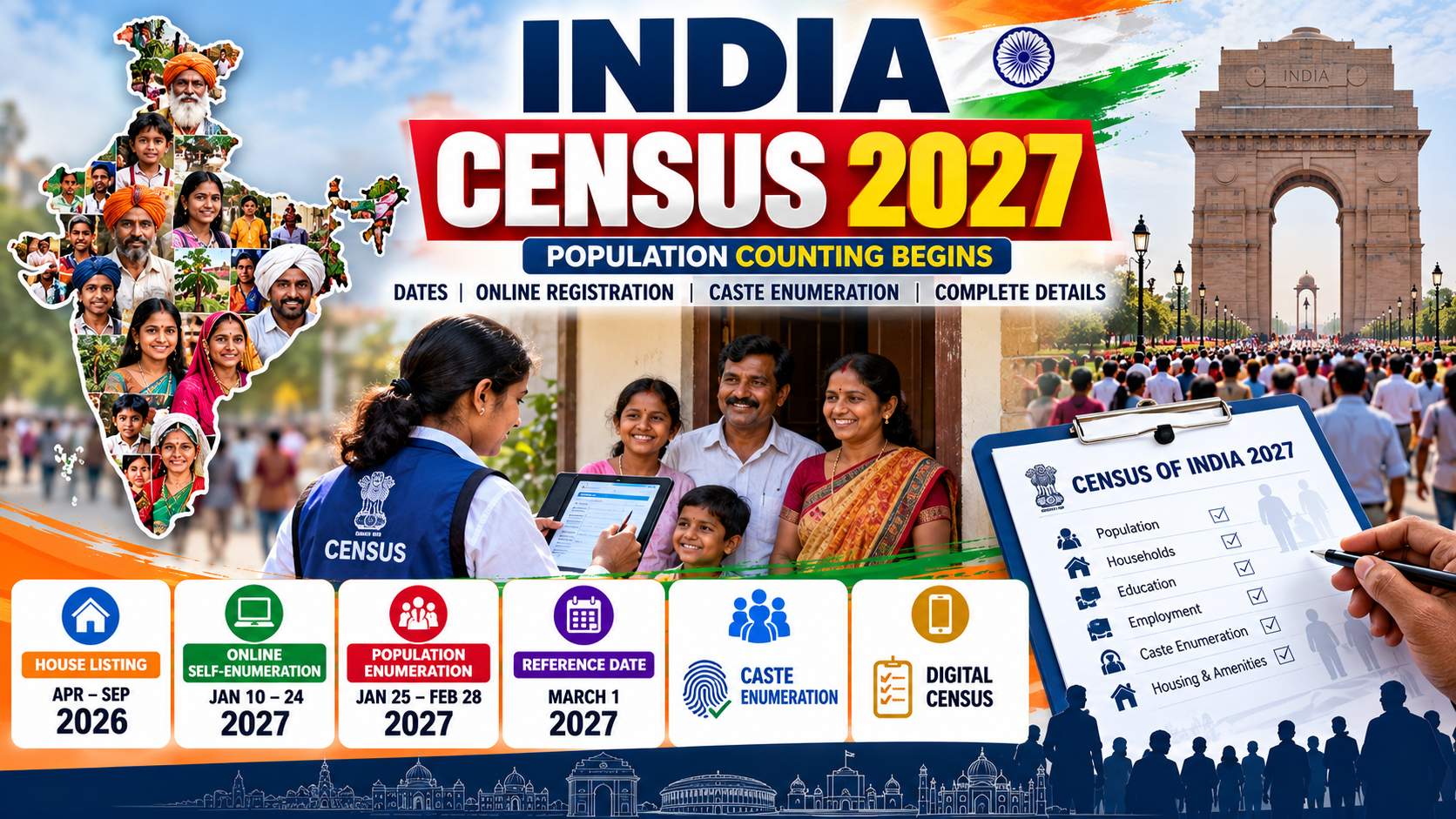
India Census 2027: Population Counting Dates, Online Self-Enumeration, Caste Census and Complete Details
India is preparing for its next nationwide population census after a gap of more than 15 years. The upcoming Census 2027 will introduce digital data collection, an optional online self-enumeration facility and comprehensive caste enumeration.
In the latest announcement on October 30, 2026, the Registrar General of India confirmed that population enumeration across most of the country will take place from January 25 to February 28, 2027. Citizens will also have an option to submit household information online from January 10 to January 24, 2027.
The exercise will provide updated information about India's population, households, education, employment, migration and other demographic characteristics.
India Census 2027: Important Details at a Glance
| Particulars | Details |
|---|---|
| Census name | Census of India 2027 |
| Previous census | 2011 |
| Census number | 16th Census |
| Since Independence | 8th Census |
| Main population counting | January 25 – February 28, 2027 |
| Online self-enumeration | January 10 – January 24, 2027 |
| Census reference date | March 1, 2027 |
| First phase | House Listing and Housing Census |
| Second phase | Population Enumeration |
| Data collection | Digital and mobile-based |
| Caste enumeration | Included |
| Approved budget | ₹11,718.24 crore |
| Field workforce | Approximately 30 lakh field functionaries |
| Responsible authority | Office of the Registrar General and Census Commissioner, India |
Latest schedule: The January 25–February 28 dates do not apply to every region. Poll-bound and certain snow-bound areas have separate arrangements. Source: The Federal, October 30, 2026.
Census 2027: Important Dates
| Event | Date |
|---|---|
| House Listing and Housing Census | April–September 2026 |
| Online self-enumeration | January 10–24, 2027 |
| Population Enumeration | January 25–February 28, 2027 |
| Revisional round | March 1–5, 2027 |
| Population reference date | March 1, 2027, midnight |
Note: The house-listing phase has its own state-wise schedule. Population enumeration dates also differ for certain poll-bound and snow-bound regions.
What Is the Latest Census 2027 News?
The latest announcement confirms the main population enumeration window for most of India.
According to the notification issued by the Registrar General of India:
Population counting will take place from January 25 to February 28, 2027, in the regions covered by this schedule.
Citizens can use the optional self-enumeration facility from January 10 to January 24, 2027.
The census reference date will be midnight on March 1, 2027.
A revisional round will be conducted from March 1 to March 5, 2027.
Manipur, Goa, Uttar Pradesh, Punjab, Uttarakhand, Ladakh and certain snow-bound areas are excluded from the main schedule.
Manipur's schedule will be announced separately. Other excluded regions will follow separate arrangements.
The schedule has been adjusted to account for upcoming Assembly elections and regional conditions.
Why Is India Conducting a Census in 2027?
India normally conducts its population census every ten years.
The previous census was conducted in 2011. The census scheduled for 2021 was postponed because of the COVID-19 pandemic.
Since then, India has experienced significant changes in population distribution, urbanisation, migration, education, employment and household living conditions.
The 2027 census is intended to provide updated information for:
Government policy planning
Healthcare infrastructure
Education and school planning
Housing and urban development
Employment and workforce analysis
Rural development
Population distribution
Welfare programme planning
Migration analysis
Infrastructure development
The census is one of the most important sources of official demographic information in India.
How Will India's First Digital Census Work?
One of the biggest changes in Census 2027 is the introduction of digital data collection.
Unlike previous census exercises that relied heavily on paper schedules, the upcoming census will use mobile applications and digital monitoring systems.
Major Digital Features
| Feature | Purpose |
|---|---|
| Mobile Census Application | Digital data collection |
| Self-Enumeration Portal | Online household information submission |
| Census Management and Monitoring System | Monitoring census progress |
| Digital Mapping | Identifying geographical census blocks |
| Secure Data Centres | Protecting collected information |
| Data Validation | Reducing errors and inconsistencies |
Enumerators will use authorised mobile applications to collect and submit information.
The government has also developed a central monitoring system to track the progress of census operations.
The digital approach is intended to improve data quality, reduce paperwork and make census results available more efficiently.
Can People Count Themselves Online?
Yes. Census 2027 introduces an optional Self-Enumeration facility.
Under this system, eligible household respondents can submit their household information through an official online portal before the house-to-house enumeration begins.
Self-Enumeration Schedule
<badge color="success">January 10–24, 2027</badge>
The process is expected to work as follows:
Visit the official Census Self-Enumeration portal.
Select the available language.
Enter the requested household information.
Review the details before submission.
Submit the information online.
Receive a unique Self-Enumeration ID.
Share the ID with the census enumerator during the verification visit.
The enumerator will verify the submitted information and integrate it into the census process.
Official portal: https://se.census.gov.in/
The self-enumeration facility is optional. Households can also provide their information directly to authorised enumerators during the field visit.
Will Caste Be Counted in Census 2027?
Yes. Comprehensive caste enumeration has been included in Census 2027.
This is one of the major changes in the upcoming census.
The Cabinet Committee on Political Affairs decided on April 30, 2025, to include caste enumeration in the exercise.
The population enumeration phase will collect caste-related information alongside other demographic and socioeconomic details.
Why Is Caste Enumeration Important?
Caste-related information can provide data for studying:
Social composition
Population distribution
Socioeconomic differences
Education patterns
Employment patterns
Social development
Welfare and policy planning
The information will contribute to a broader understanding of India's social and demographic structure.
The actual questionnaire and classification methodology should be understood from the official census instructions rather than assumptions or unofficial lists.
What Information Will Be Collected During the Census?
The census is designed to collect information about households and individuals.
The exercise has two major phases.
Phase 1: House Listing and Housing Census
The first phase focuses on houses, household facilities and living conditions.
Information includes areas such as:
Type of building
Housing conditions
Number of rooms
Drinking-water availability
Electricity
Toilet facilities
Cooking fuel
Household assets
Internet and communication facilities
Household amenities
Phase 2: Population Enumeration
The second phase focuses on individual-level demographic and socioeconomic information.
It covers areas such as:
Age
Gender
Marital status
Education
Occupation
Migration
Fertility
Caste
Other demographic characteristics
The exact questions and instructions should be checked against the officially notified schedules for each phase.
How Much Will Census 2027 Cost?
The Union Cabinet has approved a budget of ₹11,718.24 crore for conducting Census 2027.
This funding will support:
Census personnel
Training programmes
Digital applications
Technology infrastructure
Data security
Field operations
Monitoring systems
Administrative arrangements
Data processing and publication
The government expects the use of digital systems to improve the efficiency of the census exercise.
How Many People Will Be Involved in Conducting the Census?
Census 2027 will require a large workforce across the country.
The government has estimated that approximately 30 lakh field functionaries will be involved in the exercise.
These personnel will include enumerators, supervisors and other census officials.
Government teachers and other appointed personnel generally undertake field enumeration in addition to their regular duties.
The government has also estimated approximately 18,600 technical personnel for around 550 days of local-level census work, generating approximately 1.02 crore man-days.
What Happens to Your Personal Information?
Privacy is an important part of the census process.
Under Section 15 of the Census Act, 1948, individual census records are treated as confidential.
According to the government:
Individual census information is confidential.
Personal information cannot be disclosed as ordinary public records.
Census records cannot be used as evidence in court.
Information is collected for statistical and census purposes.
The digital census will also use security measures such as encryption and secure data infrastructure.
People should provide information only through authorised census officials and official government portals.
What Is India's Current Population?
India's last completed official population census was conducted in 2011.
| Census Year | Population |
|---|---|
| 1951 | 36.1 crore |
| 1961 | 43.9 crore |
| 1971 | 54.8 crore |
| 1981 | 68.3 crore |
| 1991 | 84.6 crore |
| 2001 | 102.9 crore |
| 2011 | 121.1 crore |
The 2011 census recorded India's population at approximately 121.1 crore.
India's current population is estimated to be substantially higher, but estimates from international organisations are not a substitute for an official Indian census count.
The final 2027 census results will provide updated official population figures.
Why Is Census 2027 Important for India's Future?
The information collected through the census will support several important areas of national development.
1. Healthcare
Population data can help authorities understand where hospitals, primary healthcare centres and other medical facilities are needed.
2. Education
Information about children, literacy and education can support school planning and educational infrastructure.
3. Employment
Occupational and workforce data can help researchers understand employment patterns and economic activity.
4. Urban Development
Population distribution and housing information can support planning for roads, transport, water supply and sanitation.
5. Rural Development
Village-level data can help identify infrastructure and public-service requirements.
6. Welfare Planning
Demographic and socioeconomic information can support the planning and evaluation of public welfare programmes.
Census 2027: What Makes It Different from Census 2011?
| Feature | Census 2011 | Census 2027 |
|---|---|---|
| Data collection | Primarily paper-based | Digital/mobile-based |
| Online self-enumeration | Not available | Optional facility |
| Caste enumeration | SC/ST enumeration | Comprehensive caste enumeration planned |
| Digital monitoring | Limited | Central monitoring system |
| Data submission | Paper schedules and processing | Digital submission |
| Mapping | Earlier mapping methods | Digital geographical tools |
| Reference year | 2011 | 2027 |
Census 2027 represents a major change in the way population information is collected and processed.
Frequently Asked Questions About India Census 2027
When will India's population census take place?
Population enumeration across most of India is scheduled from January 25 to February 28, 2027.
When can I submit my census details online?
The optional self-enumeration period is scheduled from January 10 to January 24, 2027.
What is the official Census 2027 website?
The official self-enumeration portal is https://se.census.gov.in/. General census information is available through the Office of the Registrar General and Census Commissioner, India.
Will census officials visit every household?
The census involves household visits by authorised enumerators. The optional online self-enumeration facility will be followed by verification.
Will caste be included in Census 2027?
Yes. Comprehensive caste enumeration has been approved for the population enumeration phase.
Is Census 2027 India's first digital census?
Yes. Census 2027 is planned as India's first census conducted through digital data collection methods.
How much money has been approved for Census 2027?
The Union Cabinet has approved ₹11,718.24 crore.
What is the reference date for Census 2027?
For most of the country, the reference date is midnight on March 1, 2027. Certain snow-bound regions have a different reference date.
Is the January 25 date applicable to every state?
No. Some poll-bound and snow-bound regions have separate schedules. Manipur's schedule is to be announced separately.
Will the census information be made public?
Individual household records are confidential under the Census Act. Statistical information and aggregated census results are used for public planning and research.
Conclusion
India's Census 2027 is an important national exercise that will provide updated information about the country's population, households, social composition and economic characteristics.
The introduction of digital data collection, optional self-enumeration and comprehensive caste enumeration makes this census different from previous exercises.
With the latest announcement confirming January 25 to February 28, 2027, as the main population enumeration window for most of India, households should keep an eye on official state-wise schedules and census instructions.
The results will help provide a clearer picture of India's changing population and support planning across healthcare, education, infrastructure, employment and public services.
For official updates, visit the Census of India website and the self-enumeration portal.